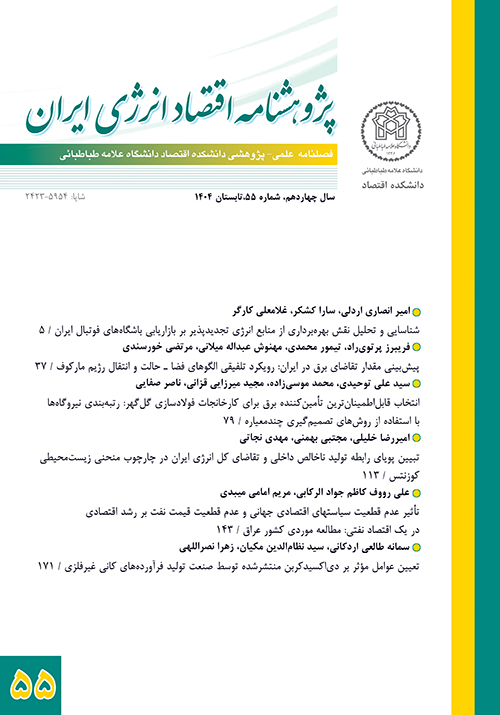
انصاری اردلی، امیر؛ کشکر، سارا و کارگر، غلامعلی. (1401). شناسایی الزامات و اقدامات مدیریت سبز در راستای توسعه پایدار استادیومهای فوتبال ایران. مطالعات مدیریت ورزشی، 14(75)، 220- 195. Doi: 10.22089/smrj.2021.10047.3312
کشکر، سارا. (1402). شناسایی و تحلیل موانع و فرصتهای بهرهبرداری از منابع انرژی تجدیدپذیر در استادیومهای فوتبال ایران. مدیریت و توسعه ورزش، 12(2)، 41-40.
https://doi.org/10.22124/jsmd.2023.6800
انصاری اردلی، امیر. (1399). نقش استفاده از انرژیهای تجدیدپذیر بر بازاریابی سبز و توسعه پایدار در استادیومهای منتخب فوتبال ایران. پایاننامه کارشناسی ارشد، دانشگاه علامه طباطبایی. صفحات 132-1.
دهقان قهفرخی، امین؛ پورشریف سورکوهی، بهاره؛ انصاری اردلی، امیر و جلالی فراهانی، مجید. (1399). اولویتبندی فناوریهای نوین قابل استفاده در اماکن ورزشی با تأکید بر کاهش مصرف انرژی. مطالعات مدیریت ورزشی، 12(64)، 150-133.
Doi: 10.22089/smrj.2020.8367.2867
گودرزی، صمد؛ باقری، قدرتالله و یزدانی، حمیدرضا. (1400). طراحی مدل عوامل مؤثر بر توسعۀ بهکارگیری انرژی تجدیدپذیر در اماکن ورزشی ایران. نشریه مدیریت ورزشی، 13(1)، 181-161. Doi: 10.22059/jsm.2019.264481.2146
جعفری، سعید؛ جلالی فراهانی، مجید و خبیری، محمد. (1399). بررسی موانع طراحی و ساخت اماکن ورزشی سبز از دیدگاه کارشناسان. نشریه مدیریت ورزشی، 12(1)، 56-35.
Doi: 10.22059/jsm.2020.216735.1695
رسولی پره یوسفیان، سعید؛ برقی مقدم، جعفر؛ جنانی، حمید؛ نجفزاده، محمدرحیم و روشن میلانی، افشین. (1401). مدیریت بهینه انرژی در اماکن ورزشی زیرمجموعه وزارت نیرو با تأکید بر انرژیهای تجدیدپذیر (مطالعه استان آذربایجان شرقی). پژوهشهای فیزیولوژی و مدیریت در ورزش، 14(1)، 176-161.
صادقی آرانی، زهرا؛ علیدوست قهفرخی، ابراهیم و امیدوار اشکلاک، مهدی. (1391). مدلسازی تعاملی مؤلفههای مدیریت زنجیره تأمین سبز در مشاغل ورزشی: رویکردی فرآیندگرا و سلسلهمراتبی. مجله مطالعات نوین در مدیریت ورزشی، 3(2)، 441-420.
یزدانی، فرشاد؛ فرقانی اوزرودی، محمدباقر و یعقوبی، علی. (1400). رابطه بین بازاریابی سبز و ادراک از معیارهای اخلاقی تولیدکنندگان با وفاداری مشتریان محصولات ورزشی. مطالعات بازاریابی ورزشی، 2(4)، 97-65.
Doi: https://www.doi.org/10.34785/J021.2022.296
Alamsyah, D., Othman, N., & Mohammed, H. (2020). The awareness of environmentally friendly products: The impact of green advertising and green brand image. Management Science Letters, 10(9), 1961-1968.http://dx.doi.org/10.5267/j.msl.2020.2.017
Ali, ABELHAK, & Ibrahim, BELHIMR. (2021). Using sports marketing methods by professional football clubs as a solution to respect the rules of fair financial play Case of Paris Saint-Germain club. Scientific Research Bulletins, 9(2), 348-359.https://www.researchgate.net.
Amis, J., Pant, N., & Slack, T. (1997). Achieving a sustainable competitive advantage: A resource-based view of sport sponsorship. Journal of sport management, 11(1), 80-96.https://doi.org/10.1123/jsm.11.1.80
Ansari ardali, A., Keshkar, S., & karegar, G. (2022). Identifying the requirements and actions for green management in relation to the sustainable development of Iranian football stadiums. Sport ManagementStudies, 14(75), 195220.
Ansari ardali, A., keshkar, S., & Karegar, G. A. (2023). Recognition and analysis of barriers and opportunities for the use of renewable energy sources in Iranian football stadiums. Sport Management and Development, 12(2), 40-41.https://doi.org/10.22124/jsmd.2023.6800. [In Persian]
Ansari Ardali, Amir. (2020). The role of using renewable energy sources on green marketing and sustainable development in selected football stadiums in Iran. Master's thesis, Allameh Tabatabai University. Pages 1-132., Master's thesis, Allameh Tabatabai University. Pages 1-132. https://aris.atu.ac.ir/keshkar. [In Persian]
Atghia, N., & Nazarian, A. (2024). Economic sustainability: a solution to the financial problems of football clubs. Sport. Business and Management: An International Journal, 14(1), 56-79.
Aquino, I., & Nawari, N. O. (2015). Sustainable Design Strategies for Sport Stadia. Suburban Sustainability, 3(1), 1-32.
Blumrodt, J., Desbordes, M., & Bodin, D. (2013). Professional football clubs and corporate social responsibility. Sport, business and management: an international journal, 3(3), 205-225.
Bodong, S., Wiseong, J., Chengmeng, L., & Khakichi, A. (2023). Economic management and planning based on a probabilistic model in a multi-energy market in the presence of renewable energy sources with a demand-side management program. Energy, 126549.
Burger, M., Graeber, B., & Schindlmayr, G. (2014). Managing energy risk: An integrated view on power and other energy markets.
Cayolla, R. R., Escadas, M., Biscaia, R., Kellison, T., Quintela, J. A., & Santos, T. (2023). Fans' perceptions of pro-environmental sustainability initiatives in sport and triple bottom line benefits. International Journal of Sports Marketing and Sponsorship, (ahead-of-print).competitive pricing of modular products for green consumers. J. Clean. Prod.142 (4), 4230e4242.http://dx.doi.org/10.1108/IJSMS-07-2022-0141
Charviandi, A. (2023). Application of Shopping Bag to Consumer Green Purchase Behavior through Green Trust, and Green Perceived Value. Journal of Artificial Intelligence and Digital Business (RIGGS), 1(2),
19-24. https://doi.org/10.31004/riggs.v1i2.22
Da Silva, E. C., & Las Casas, A. L. (2017). Sports marketing plan: an alternative framework for sports club. International Journal of Marketing Studies, 9(4), 15-28.http://dx.doi.org/10.5539/ijms.v9n4p15
Dangelico, R.M., Vocalelli, D., 2017. Green Marketing: an analysis of definitions, strategy steps, and tools through a systematic review of the literature. J. Clean. Prod. 165, 1263e1279.
Dingle, G. W., & Stewart, B. (2018). Playing the climate game: Climate change impacts, resilience and adaptation in the climate-dependent sport sector. Managing Sport and Leisure, 23(4-6), 293-314.
Dehghan Ghahfarokhi, A., Pur Sharif Surkuhi, B., Ansari Ardali, A., & Jalali Farahani, M. (2021). Prioritizing New Usable Technologies in Sports Facilities with an Emphasis on Reducing Energy Consumption. Sport Management Studies, 12(64), 133-150.
Du, X., Xie, W., & Guan, W. (2024). Energy transition in sport and public facilities: pioneering sustainable economic pathways. Economic Change and Restructuring, 57(2), 44. https://doi.org/10.1007/s10644-024-09616-x
Elnour, M., Fadli, F., Himeur, Y., Petri, I., Rezgui, Y., Meskin, N., & Ahmad, A. M. (2022). Performance and energy optimization of building automation and management systems: Towards smart sustainable carbon-neutral sports facilities. Renewable and Sustainable Energy Reviews, 162, 112401.https://doi.org/10.1016/j.rser.2022.112401
Goodarzi, S., Bagheri, G., & Yazdani, H. (2021). Developing the Model of Factors Affecting the Development of Renewable Energy Use in Iran Sport Facilities. Sport Management Journal, 13(1), 161-181. doi: 10.22059/jsm.2019.264481.2146. [In Persian]
Katsaprakakis, D. A., Dakanali, I., Zidianakis, G., Yiannakoudakis, Y., Psarras, N., & Kanouras, S. (2019). Potential on Energy Performance Upgrade of National Stadiums: A Case Study for the Pancretan Stadium, Crete, Greece. Applied Sciences, 9(8), 1544-1575.
Kellison, T. B., Trendafilova, S., & McCullough, B. P. (2015). Considering the social impact of sustainable stadium design. International Journal of Event Management Research, 10(1), pp 63-83.
keshkar, S. (2023). Recognition and analysis of barriers and opportunities for the use of renewable energy sources in Iranian football stadiums. Journal of Sport Management and Development, 12(2), 1-27.
Lorgnier, N. (Ed.). (2017). Routledge handbook of football marketing. Taylor & Francis Limited. https://doi.org/10.4324/9781315267203
Liu, Z., Ahmad, I., Perveen, Z., & Alvi, S. (2023). Do the globalization and imports of capital goods from EU, US and China determine the use of renewable energy in developing countries?. Carbon Management, 14(1), 1-12. https://doi.org/10.1080/17583004.2023.2165162
Luan, N. T., Hau, D. N. D., & Thu, N. T. A. (2022). The Influence of Green Product Development Performance to Enhance Enterprise Effectiveness and Innovation. Economies, 10(5), 113.
Mabon, L. (2022). Football and climate change: what do we know, and what is needed for an evidence-informed response? Climate Policy, 1-15.https://doi.org/10.3390/en11092396
Manni, M., Coccia, V., Nicolini, A., Marseglia, G., & Petrozzi, A. (2018). Towards zero energy stadiums: The case study of the Dacia arena in Udine, Italy. Energies, 11(9), 2396.https://doi.org/10.3390/en11092396
Mathew, M. D. (2022). Nuclear energy: A pathway towards mitigation of global warming. Progress in Nuclear Energy, 143, 104080.
McCullough, B. P., Casper, J. C., & Kushner Smith, D. M. (2022). Fan Responses of Sponsored Environmental Sustainability Initiatives. Sustainability, 14(21), 14062. https://doi.org/10.3390/su142114062
McCullough, B. P., Orr, M., & Kellison, T. (2020). Sport ecology: Conceptualizing an emerging subdiscipline within sport management. Journal of Sport Management, 34(6), 509 520.
Nai-Jen, C., & Cher-Min, F. (2010). Green product quality, green corporate image, green customer satisfaction, and green customer loyalty. African journal of business management, 4(13), 2836-2844.
Nekmahmud, M., & Fekete-Farkas, M. (2020). Why not green marketing? Determinates of consumers’ intention to green purchase decision in a new developing nation. Sustainability, 12(19), 7880.
Perera, F., Ashrafi, A., Kinney, P., & Mills, D. (2019). Towards a fuller assessment of benefits to children's health of reducing air pollution and mitigating climate change due to fossil fuel combustion. Environmental research, 172, 55-72.https://doi.org/10.1016/j.envres.2018.12.016
Polonsky, M. J. (2011). Transformative green marketing: Impediments and opportunities Journal of Business Research, pp. 1-9.
Peyman, Z., & afshari, M. (2021). The analysis of sponsor’s participation in the sports events based on sponsorship motivation matrix (case study, football Primer ligue of Iran). Sport Management Studies, 12(64), 207-232. https://doi.org/10.22089/smrj.2020.9124.3091. [In Persian]
Rasouli pareh yousefian, S., Barghi Mogaddam, J., Janani, H., Najafzadeh, M. R., & roshan milani, A. (2022). Optimal energy management in sports venues under the Ministry of Energy with emphasis on renewable energy (East Azerbaijan Province). Sport Physiology & Management Investigations, 14(1), 161-176.
Rezaei, F., Honari, H., Ghafouri, F., & Aghayi, T. (2022). The effects of green marketing drivers on the Performance of sport facilities with the mediating role of social responsibility. Sports Marketing Studies, 3(1), 171-144. HTTPS://WWW.DOI.ORG/10.34785/J021.2022.006. [In Persian]
Rosner, S., & Shropshire, K. (Eds.). (2011). the business of sports. Jones & BartlettPublishers.https://books.google.com/books?id=owSi55tLZAC&newbks=0&hl=en
Sfintes, R. (2020). Football stadium: An energy-efficient building and a source of renewable energy for the community. Energy efficient building design, 171-184. https://doi.org/10.1007/978-3-030-40671-4_11
Saedi, A. H., & Ahmadi, A. (2023). Life cycle assessment of Iran energy portfolio: Renewable energy replacement approach. Energy Science & Engineering. https://doi.org/10.1002/ese3.1422
Saengchai, S., Rodboonsong, S., & Jermsittiparsert, K. (2019). Environmental regulation, green product innovation and performance: Do the environmental dynamics matter in thai sports industry? Journal of Human Sport and Exercise, 14(Proc5), S2276-S2289.
Silveira, M. P., Cardoso, M. V., & Quevedo-Silva, F. (2019). Factors influencing attendance at stadiums and arenas. Marketing Intelligence & Planning, 37(1), 50-65. doi.org/10.1108/MIP-02-2018-0048
Söderman, S. (2023). Chinese and other perspectives on football. In The Footballization of China (pp. 1-30). Edward Elgar Publishing. doi.org/10.4337/9781803928265.00006
Solvalier, I. (2010). Green Marketing Strategies-Case Study about ICA Group AB. Karlstad University, Sweden. pp 1-107. https://www.diva-portal.org/smash/get/diva2:324611/FULLTEXT04
Biel, J., Finger, T., Niemann, A., Reinke, V., Kossakowski, R., Jungblut, J., & Llopis‐Goig, R. (2023). A European public sphere united by football: a comparative quantitative text analysis of German, Norwegian, Polish and Spanish football media. JCMS: Journal of Common Market Studies. https://doi.org/10.1111/jcms.13559
Stemler, S. (2001). An overview of content analysis. Practical Assessment, Research & Evaluation, 7(17), 137-46. https://doi.org/10.7275/z6fm-2e34
Szczepkowski, J. (2021). Building and maintaining the relationship with football fans during COVID-19. Journal of Physical Education and Sport, 21, 1270-1275. DOI:10.7752/jpes.2021.s2161
León-Quismondo, J. (2021). Sustainability Marketing in the National Football League (NFL): The Case of the Philadelphia Eagles. In Social and Sustainability Marketing (pp. 721-738). Productivity Press.
Lobillo Mora, G., Ginesta, X., & de San Eugenio Vela, J. (2021). Corporate social responsibility and football clubs: the value of environmental sustainability as a basis for the rebranding of real Betis Balompie in Spain. Sustainability, 13(24), 13689. https://doi.org/10.3390/su132413689
Lyu, S. O. (2024). Unveiling willingness to pay for green stadiums: Insights from a choice experiment. Journal of Cleaner Production, 434, 139985. https://doi.org/10.1016/j.jclepro.2023.139985
Panferov, D., & Averin, A. (2020). Improvements of football clubs’ marketing strategies in Russian reality. Laisvalaikio tyrimai, 2(16).
Wanless, L., Seifried, C., & Kellison, T. (2023). Renewable energy source diffusion in professional sport facilities. Journal of Sport Management, 1(aop), 1-13. https://doi.org/10.1123/jsm.2023-0081
Wu, Mf. (2023). Toward sustainable energy management of a sports complex with use of solar energy and thermal demand management. J. Cent. South Univ. 30, 3586-3600. https://doi.org/10.1007/s11771-023-5486-2.
Zahedi, R., Zahedi, A., & Ahmadi, A. (2022). Strategic study for renewable energy policy, optimizations and sustainability in Iran. Sustainability, 14(4), 2418.https://doi.org/10.3390/su14042418.